Anna’s camera
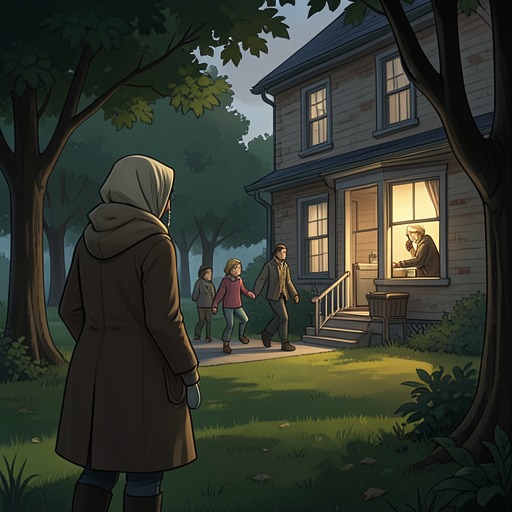
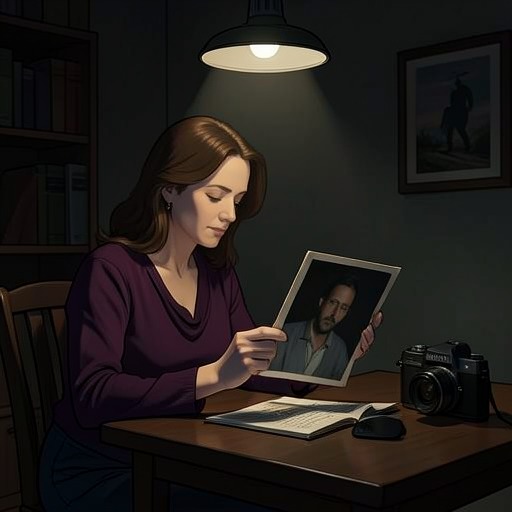
The Woman in the WindowAnna’s camera is both a tool of surveillance and a frame for her uncertain knowledge of the neighbors. She uses it to watch Alistair Russell enter the Russells’ house at 207 and to study a woman crossing the park toward her; the scenes show how looking can become an attempt to gather evidence, without making the camera a guarantee that Anna understands what she sees.
Use as an Instrument of Surveillance
When Alistair Russell arrives, Anna takes a photograph as he gets out of his car and another when he reaches the door. She admits that she has no plan and does not expect to see proof such as blood on his hands or hear a confession at her own door. The camera does not supply a clear investigative method: Anna’s immediate purpose is simply to watch. That distinction matters. The photographs mark particular moments, but her attention continues beyond the shutter, following his movements after he enters the house.
Anna’s lens shifts to the kitchen, where she sees Alistair appear, slap his keys on the counter, shrug off his coat, and leave the room. He does not return. These observations give her small, concrete details of his arrival and conduct, but not an explanation of what he is doing or where he goes. The camera narrows the distance between Anna’s house and the Russells’ interior while leaving the central uncertainty intact. It allows her to observe a sequence; it cannot turn that sequence into a confession or establish what happened outside her view.
Looking Through the Viewfinder
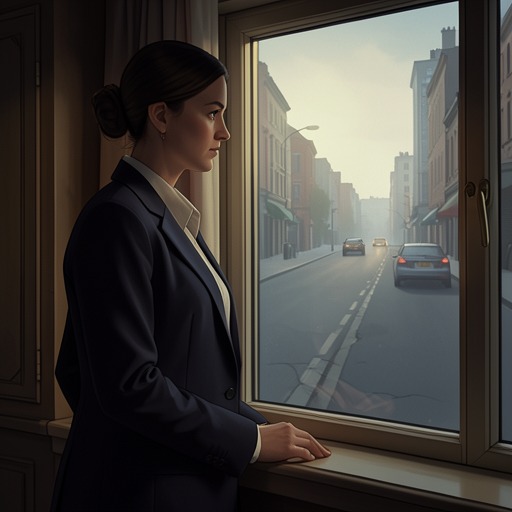
In another scene, Anna looks through the blinds toward the Russells’ front door as it opens in the rain. While Ed tells her to take care of herself, she turns to the camera, raises it to her eye, and focuses on the woman who has appeared on the stoop. Anna’s attention is divided: Ed is speaking beside her, but the viewfinder directs her toward the scene across the park. The camera makes that choice visible, shifting the moment from a conversation at home to an act of observation directed outward.
Anna first registers the woman’s red knee-length coat and translucent half-moon umbrella. She then lowers the lens and zooms in on the woman’s face, noticing her nose, pale skin, and the dark appearance beneath her eyes. Anna infers that the woman has not been sleeping. The detail is important as an act of interpretation, not as proof of the woman’s condition: the camera brings her face closer, but Anna supplies the meaning of what she sees. The sequence distinguishes a visible feature from a conclusion drawn from it.
The scene does not say that Anna takes a photograph of the woman. Instead, it follows her changing use of the camera: she lifts it, peers through the viewfinder, lowers the lens, and zooms in. The device serves first to locate and then to examine its subject. As the woman descends the steps, checks her phone, puts it away, and turns east toward Anna, her face remains blurry behind the curve of the umbrella. Greater attention has not made the view complete.
Limits and Narrative Significance
Across these episodes, the camera makes Anna an observer of events unfolding beyond her home, but it also organizes what remains inaccessible. She can photograph Alistair at the car and the doorway, then follow his brief appearance in the kitchen; she cannot see his hands rinsed in blood or make him explain himself. She can bring the woman’s face closer, yet the umbrella obscures it as the woman approaches. In both cases, the instrument sharpens some details while leaving the larger situation unresolved.
The camera therefore carries a double significance. It gives Anna a means of directing her attention when she is confined inside, and it turns watching into a sustained action rather than a passing glance. At the same time, the scenes resist treating recorded or magnified sight as complete knowledge. Anna’s images and observations may help her attend to what is happening across the park, but what she sees remains partial, and the urge to keep looking does not by itself resolve her uncertainty.